Current invoices
Send a timely request with the original invoice, amount and due date before the receivable becomes past due.
Transform aging invoices into actionable digital payment requests, give customers clearer information before they pay, and connect confirmed payments to the correct receivable and bank account.
Build My Real-Time Receivables WorkflowToday Payments is not a bank or the Federal Reserve. Product availability, approval, timing, aliases and network capabilities depend on participating financial institutions and providers.
An accounts-receivable aging report explains what is outstanding. A Request for Payment can help the business do something about it. When invoice data, payer identity, request status, payment confirmation and accounting records stay connected, a finance team can move from passive reporting to active collection management.
The merchant is the Payee (Creditor), and the customer is the Payer (Debtor). The payee sends an RfP through an eligible service. The payer reviews the obligation and, when ready, authorizes a payment through its financial institution or chooses another payment option presented by the merchant. The RfP carries information; it does not itself move or pull money.

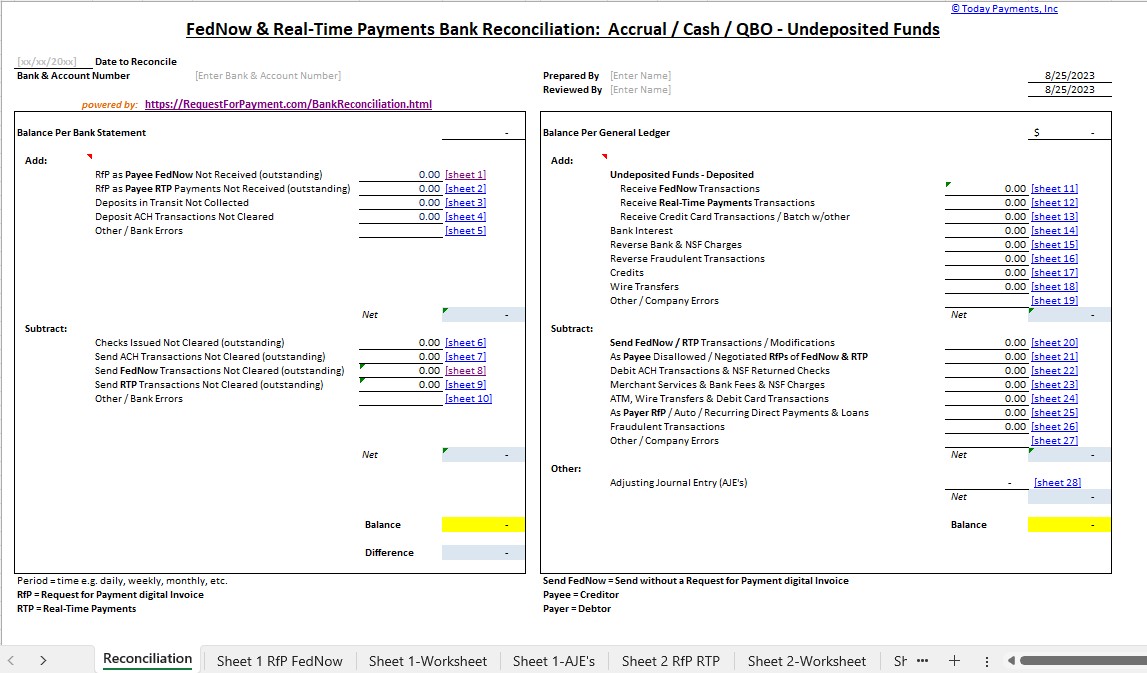
To support merchants and finance teams of all sizes, TodayPayments.com offers free downloadable templates, including:
Traditional positive pay helps a bank compare checks presented for payment with a file supplied by the business. In an instant-payment RfP workflow, “positive pay” is used as a business-control concept: the payer receives a structured request, verifies the payee and invoice, and approves the related payment before funds move.
This approve-before-pay approach can support vendor validation, separation of duties, amount limits, duplicate detection, supervisory review and exception routing. It is not a native FedNow product called “Positive Pay,” and an RfP response is not proof of settlement. Confirmation of the associated instant credit transfer must be tracked separately.
Send a timely request with the original invoice, amount and due date before the receivable becomes past due.
Issue a courteous reminder RfP and track whether it was delivered, viewed or left unanswered.
Escalate the collection workflow, confirm payer and payee data, and offer eligible payment choices.
Route exceptions to a collector, review disputes and require supervisor approval for modified terms.
Apply collection policy, credit holds or structured payment options while preserving the complete request history.
Use confirmed settlement and remittance references to apply cash and close the correct receivable.
Request status and payment status must remain separate. “Sent,” “delivered,” “viewed,” “accepted” or “scheduled” does not necessarily mean that money has settled. The A/R record should be marked paid only after the business receives reliable payment confirmation.
Today Payments can present an invoice or payment request through the communication channel appropriate for the customer relationship. A mobile alert, email, SMS message, text-to-pay notice or QR code can direct the payer to a secure destination where the invoice and merchant details can be reviewed.
The Dashboard Hosted Payments Page becomes the payer’s information and choice center. It can display the merchant name, invoice number, amount, due date, line items, service period, supporting documents and available payment methods. Depending on eligibility, those options may include a FedNow-enabled instant payment, ACH, card, buy now/pay later, customer financing or another supported rail.
A merchant with multiple divisions, subsidiaries, locations or brands can associate each hosted page with an internal merchant account or MID. Routing rules can coordinate the invoice entity, page, alias and intended deposit account. These MIDs are platform-level identifiers; they are not identifiers issued by the FedNow Service.
The hosted page lets Today Payments keep the accounting and customer experience consistent even when payment rails differ. Each rail still retains its own authorization, settlement, fee, return and dispute rules. The platform should never describe a card authorization, ACH initiation or accepted RfP as if it were confirmed FedNow settlement.
A verified email address, mobile number or other proxy may create a simpler payer experience than displaying a routing number and account number. The alias is a presentation and directory identifier—not a replacement for the underlying account relationship that financial institutions need to route and settle a payment.
Alias availability varies by bank, credit union, network, directory and provider. Strong data hygiene should connect every alias to the correct legal entity, DBA, internal MID, deposit account and accounting company. Changes should require verification and dual control because compromised aliases can redirect funds.
| Category | Representative parameters | Business purpose |
|---|---|---|
| Message identity | Message ID, creation timestamp, request ID, instruction ID, end-to-end ID | Uniqueness, duplicate prevention and traceability |
| Payee (Creditor) | Legal/display name, account or supported alias, servicing institution | Identifies the party requesting and receiving payment |
| Payer (Debtor) | Name, customer reference, account relationship or supported proxy | Directs the request to the intended customer |
| Amount and timing | Requested amount, currency, due date, requested execution date, expiry | Defines the obligation and action period |
| Invoice data | Invoice number, customer ID, purchase order, tax, discount and service period | Supports review, dispute resolution and cash application |
| Remittance | Structured invoice references and permitted unstructured text | Connects the request and resulting payment to A/R |
| Hosted experience | Tokenized HTTPS link, QR token and hosted-page identifier where permitted | Provides detailed invoice content and payment choices |
| Recurring controls | Consent reference, permitted merchant, limit, frequency, notification and expiry | Defines the scope of a standing approval |
| Accounting routing | Company, class, department, subsidiary, location, MID and deposit account | Posts funds and fees to the correct books |
| Lifecycle status | Created, sent, delivered, viewed, responded, paid, expired, returned and exception | Creates an auditable collection and reconciliation trail |
Participating financial institutions can send and receive eligible FedNow payments continuously, including weekends and holidays.
Accepted instant credit transfers are designed to settle within seconds and make funds available promptly, subject to applicable rules and controls.
Confirmed settlement provides stronger certainty than an accepted request or uploaded file, while legitimate return requests and error procedures can still exist.
Structured ISO 20022 data can improve invoice matching, analytics and straight-through processing.
Collection teams can see which invoices need a new request, reminder, exception review or cash application.
Mobile, email, SMS, text and QR experiences reach customers where they are ready to act.
A hosted page can present eligible real-time payment, ACH, card, BNPL or financing options without fragmenting the invoice record.
Coordinate business units, aliases, internal MIDs, deposit accounts and accounting dimensions.
Use stable request, invoice and end-to-end references to reduce unidentified cash and manual posting.
Notify finance teams when requests expire, payments settle or transactions require investigation.
Customers review the request and authorize payment through the options their providers support.
Preserve request, response, approval, payment and reconciliation events with timestamps and users.
A business can upload or schedule many invoice requests together, but each instant payment remains an individual transaction with its own identity, screening and outcome. A batch can therefore contain paid, rejected, expired, invalid or pending items. File acceptance is not settlement.
A standing approval is a payer’s documented instruction authorizing future transactions that stay within defined conditions. Those conditions should identify the merchant, amount or maximum, frequency, funding account, dates, notice requirements and cancellation process. The payer’s financial institution or provider must support the arrangement.
FedNow transactions are instant credit transfers, not merchant-initiated debit transactions. An RfP asks for payment; it does not pull funds. “Set it and forget it” can describe a convenient customer experience, but it should not imply that Today Payments can debit an account without an authorized initiation method or bypass the payer’s provider.
Once an eligible FedNow payment is accepted and settled, it is designed to be final and funds are generally available promptly. Nevertheless, legitimate return requests, mistakes and fraud-handling procedures may still apply; “final” should not be marketed as “no returns under any circumstances.”
| Format | Use in the workflow | Important distinction |
|---|---|---|
| Excel / CSV | Merchant batch intake, review and exception export | Must be validated and transformed; it is not a native FedNow message |
| JSON | APIs, hosted pages, accounting connectors and webhook events | Uses provider-specific schemas rather than the network XML specification |
| XML | Serialization for ISO 20022 and some bank interfaces | Well-formed XML is not automatically valid for a network implementation |
| ISO 20022 | Structured RfP, status and credit-transfer messaging | The current FedNow usage guide defines allowed versions, elements and rules |
The standard ISO 20022 unstructured-remittance element is commonly limited to 140 characters, not 145. Today Payments may expose a 145-character composition field in its own interface, but the integration must validate, shorten or map that value into permitted fields before producing a network message. Hosted-page links should be concise, tokenized, HTTPS-secured and allowed by the receiving implementation; not every banking channel will render an active hyperlink.
The exact mandatory and conditional fields come from the current FedNow ISO 20022 implementation guide. A practical minimum design should be prepared to supply the following groups:
| Data group | Practical minimum |
|---|---|
| Business Application Header | Sender, receiver, business-message ID, message-definition ID, service ID and creation time as required. |
| Group header | Unique message ID, creation timestamp, initiating party and transaction count where applicable. |
| Payment information | Payment-information ID, payment context, requested timing and routing context. |
| Transaction identification | Instruction ID and/or end-to-end ID plus a unique request reference. |
| Amount | Requested amount and supported currency—ordinarily USD for domestic FedNow transactions. |
| Parties | Creditor/payee and debtor/payer information required by the use case. |
| Agents and accounts | Servicing financial institutions plus account or supported proxy information. |
| Remittance | Sufficient structured or permitted unstructured data to identify the invoice or obligation. |
| Controls | Expiry, purpose, requested response and other conditional fields required by the implementation. |
ISO’s catalogue identifies pain.013 as the Creditor Payment Activation Request and pain.014 as its status report. Version numbers change over time. The resulting funds movement is a separate customer credit transfer, so neither an RfP nor its response alone proves settlement.
A FedNow RfP workflow can give a payer structured information about the merchant, invoice, amount and due date before the payer authorizes an instant credit transfer through a participating financial institution. This approve-before-pay process can complement accounts-payable verification and fraud controls.
Businesses can create collection rules for current, 1–30, 31–60, 61–90 and 90-plus-day invoices, then issue or escalate RfPs based on each aging bucket. Request status and confirmed payment data can feed the collection queue and help automate cash application.
A verified phone number, email address or other proxy may be used when the connected bank, credit union, directory and provider support it. The alias simplifies presentation but must resolve securely to an eligible underlying account relationship.
A Today Payments hosted-page workflow can use merchant, subsidiary, location, invoice and internal MID data to select the intended eligible deposit account. Strong master-data controls are essential to prevent a page or alias from sending money to the wrong legal entity.
Merchants can batch invoice requests at the software layer and schedule recurring workflows when supported. Each associated FedNow payment is still processed and reconciled individually, and the payer’s provider must support any standing-approval or automated-initiation arrangement.
Today Payments helps merchants turn aging invoices into connected payment opportunities. Combine digital invoicing, RfP presentation, positive-pay-style payer controls, hosted payment pages, eligible payment choices, multi-account routing and accounting-ready reconciliation.
Give customers the information they need to pay confidently. Give collectors a clearer view of every request and exception. Give finance teams verified payment data that can close the right invoice and update the right account.
Start Building with Today Payments
Disclosure: Today Payments, Inc. is a financial-technology and merchant-services company, not a bank, the Federal Reserve or the FedNow Service. FedNow® is a registered service mark of the Federal Reserve Banks. No endorsement or certification is implied. Availability, approval, timing, limits, finality, returns, aliases, hyperlinks, recurring functions and payment choices depend on participating financial institutions, providers and applicable rules.